Whether you are a music historian analyzing country roots, a worship leader structuring an acoustic set, or a musician attempting to capture an authentic country accent, Hank Williams I Saw the Light remains one of the most essential study cases in American music history.
Despite its iconic status today, the song presents a unique historical puzzle: why did a track that initially failed to chart in 1948 eventually become a cornerstone of gospel and secular roots music? Furthermore, how can contemporary musicians navigate its deceptively simple structure without losing the vocal urgency that makes the original so compelling?
Understanding Hank Williams I Saw the Light requires looking beyond the basic three-chord progression. By examining its composition history, analyzing its vocal delivery, and exploring practical arrangement options, musicians and fans alike can gain a deeper appreciation for this landmark piece.
The Origin Story: How “I Saw the Light” Was Born
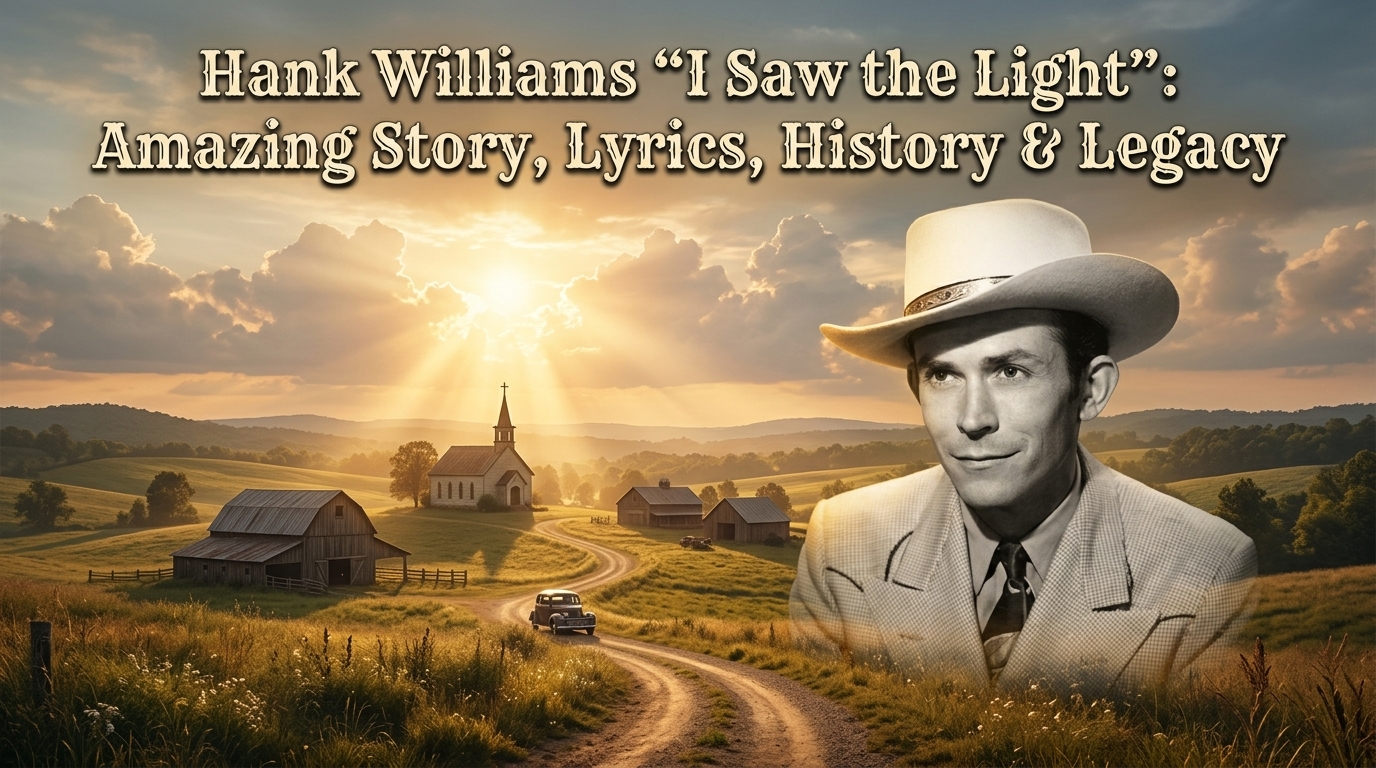
To hear why it sounded that way, you need to know the story behind the 1947 song. Hank Williams was on his way home to Montgomery after a gig in Fort Deposit, Ala. His mother was driving while he nodded off in the backseat.
When she saw the lights of Montgomery’s airport as they drew closer, his mother nudged him, saying, “Honey, you can see the light.”
Williams transformed the beacon into a spiritual metaphor. He wrote the words to this country gospel hit shortly after he returned home that day.
When MGM Records released Hank Williams I Saw the Light in September 1948, commercial expectations were high. However, the initial release failed to achieve commercial chart success. Country radio stations at the time were hesitant to promote gospel records aggressively, and gospel audiences sometimes viewed secular honky-tonk singers with suspicion.
It was only through repeated live radio broadcasts—most notably on the Louisiana Hayride and later the Grand Ole Opry—that the song embedded itself in the public consciousness, eventually becoming a staple closer for his live performances.
+———————————————————————–+
| Key Historical Milestones |
+——————-+—————————————————+
| Composition Date | Early 1947 (written en route to Montgomery, AL) |
+——————-+—————————————————+
| Primary Recording | January 1947 (Castle Studio, Nashville, TN) |
+——————-+—————————————————+
| Release Date | September 1948 (MGM Records) |
+——————-+—————————————————+
| Chart Standing | Did not chart upon initial 1948 release |
+——————-+—————————————————+
| Legacy Impact | Posthumously inducted into Gospel Music Hall |
| | of Fame (2009) |
+——————-+—————————————————+
Key Musical Factors Influencing the Track
The lasting power of Hank Williams I Saw the Light stems from a deliberate blending of traditional sacred conventions with secular honky-tonk music arrangements. Analyzing these factors helps clarify why the composition resonates across genre boundaries.
- Traditional Hymnody Adaptation: Williams drew melodic inspiration from earlier gospel standards, most notably Albert E. Brumley’s 1939 gospel composition “The Great Speckled Bird” and traditional camp-meeting revivals.
- The Honky-Tonk Rhythm Section: Unlike traditional church organ arrangements of the late 1940s, Williams backed Hank Williams I Saw the Light with a driving, mid-tempo 2/4 rhythm, driven by an upright bass, rhythm guitar, and steel guitar fill-ins.
- Vocal Urgency and Resonance: Williams employed a direct, colloquial vocal delivery. His signature vocal break—often shifting between a chest register and a light falsetto—imparted a personal sense of conviction that contrasted sharply with formal choir styles.
- Lyrical Contrast: The verses deal directly with themes of wandering, moral conflict, and distress, making the relief expressed in the chorus feel earned rather than superficial.
Technical Breakdown: Chords, Structure, and Performance
For rhythm guitarists and vocalists, performing Hank Williams I Saw the Light appears simple on paper, but executing it naturally requires attention to timing and dynamics.
Standard Progression and Key Options
The original 1947 recording is set in the key of F Major, which fit Williams’ high-tenor vocal range. For modern guitarists, playing in F Major directly can be awkward without a capo.
- Capo Approach (Recommended): Place a capo on the 1st fret and play using key of E Major shapes, or place a capo on the 10th fret using key of C Major shapes.
- Open Key Alternative (Key of G): Many live acoustic acts transpose Hank Williams I Saw the Light to the key of G Major for easier vocal range access and open-string resonance.
Key of F Major (Original Recording):
Verse / Chorus:
| F | F | F | F |
| Bb | Bb | F | F |
| F | F | F | F |
| C7 | C7 | F | F |
Transposed Key of G Major (Common Live Standard):
Verse / Chorus:
| G | G | G | G |
| C | C | G | G |
| G | G | G | G |
| D7 | D7 | G | G |
Strumming and Rhythm Mechanics
To capture the authentic feel of Hank Williams I Saw the Light, avoid standard 4/4 down-strum patterns and study the country guitar strumming pattern that gives the song its distinctive rhythm. The song relies on a traditional “boom-chick” country rhythm:
- On Beat 1, strike the root bass note of the chord.
- On the beat’s off-beat, perform a light down-strum across the treble strings.
- On Beat 2, strike the secondary bass note (the 5th interval of the chord).
- On the off-beat, perform another light down-strum.
Maintaining this steady alternation between primary and secondary bass notes gives Hank Williams I Saw the Light its characteristic forward propulsion without forcing the tempo to speed up.
Common Mistakes to Avoid When Performing
When bands or solo artists cover Hank Williams I Saw the Light, several common arrangement missteps can detract from the performance:
- Over-Complicating the Chord Voicings: Adding major 7th or 9th extensions breaks the traditional gospel feel. Stick strictly to plain triads and dominant 7th chords on the V chord.
- Rushing the Tempo: It is easy to accelerate during the chorus due to its energetic melody. Keep the pulse stable; the power comes from the vocal phrasing, not rapid tempos.
- Ignoring Call-and-Response Vocal Options: The chorus of Hank Williams I Saw the Light is designed for multi-part vocal harmonies or congregation/audience response. Singing it completely solo without dynamic variation in the chorus can feel flat.
- Over-Singing the Vocal Breaks: While Williams used vocal breaks and subtle yodels naturally, forcing artificial vocal flips can sound gimmicky. Keep the vocal delivery direct and honest.
Comparing Notable Versions and Adaptations
Examining how other artists have approached Hank Williams I Saw the Light provides practical ideas for building custom arrangements.
| Artist / Group | Key / Arrangement Style | Notable Characteristics |
| Hank Williams (1947) | Key of F / Mid-tempo Country | Original template featuring steel guitar and fiddle fills; raw vocal delivery. |
| Roy Acuff (1949) | Key of G / Traditional Bluegrass | High-tenor lead vocals with prominent banjo drive and sacred vocal harmonies. |
| Johnny Cash (1970s) | Key of E / Boom-Chicka-Boom | Lower baritone register, emphasizing the steady bass line and rhythm guitar. |
| The The (1994) | Key of D / Alternative Roots | Slowed-tempo interpretation focusing on stark acoustic instruments and darker tones. |
By analyzing these interpretations, performers can decide whether to maintain a traditional 1940s honky-tonk feel, shift toward a high-energy bluegrass tempo, or deliver a stripped-down solo acoustic rendering of Hank Williams I Saw the Light.
Practical Checklist for Solo and Band Performances
If you are preparing to include Hank Williams I Saw the Light in an upcoming set, run through this practical checklist during rehearsal:
- [ ] Determine the Vocal Key: Ensure the highest note on the IV chord transition fits comfortably within the singer’s chest voice.
- [ ] Lock the Bass Note Pattern: Confirm the bass player or rhythm guitarist is consistently alternating between the root and 5th notes on the I, IV, and V chords.
- [ ] Assign Harmony Roles: Decide who handles the high-harmony parts on the phrase “I saw the light” during the main chorus loops.
- [ ] Plan Fill-In Spaces: Ensure lead instruments (fiddle, steel guitar, or lead guitar) only execute fills between vocal phrases rather than stepping over the lyrics.
- [ ] Establish an Ending: Choose between a sudden hard stop on the I chord or an extended 3-time tag repetition on the final line of Hank Williams I Saw the Light.
The Lasting Cultural Legacy of “I Saw the Light”
And, most significantly, Hank Williams I Saw the Light demonstrates how you can reconcile country secularism with religious sentiments. His life was undoubtedly as messy and difficult as his writing was straightforward, yet through this song, he penned a crystal-clear, undeniable statement of salvation that was greater than his current realities. Indeed, anchoring a relatable narrative of striving with a universally intelligible three-cord structure turned this song into not only a monument of American popular music, but remains-just over 80 years on-the most convincing demonstration one has to this very day of the power to communicate deep, sincere emotions via maximally-economic means.
Frequently Asked Questions
1. When was “I Saw the Light” recorded by Hank Williams?
The original studio track was recorded on January 21, 1947, at Castle Studio inside the The Hermitage Hotel in Nashville, Tennessee, and subsequently released by MGM Records in September 1948.
2. Did “I Saw the Light” hit number one on the charts when released?
No, the single initially failed to chart upon its release in 1948. Its widespread popularity grew over time through live radio broadcasts, eventual covers by major gospel and country artists, and posthumous releases.
3. What chords are used in Hank Williams’ original version?
The song follows a standard three-chord I-IV-V progression. In its original key of F Major, the chords used are F Major (I), B-flat Major (IV), and C dominant 7th (V7).
4. What inspired Hank Williams to write “I Saw the Light”?
It happened during an early morning road trip he made back to Montgomery, Alabama in 1947. His mother pointed out and exclaimed when she saw lights in the sky, marking the Montgomery airport runways. Williams wrote the hit gospel song later that day.
5. What genre does “I Saw the Light” belong to?
The track sits at the intersection of Country, Southern Gospel, and Honky-Tonk music. It mixes traditional spiritual lyrics with a driving secular country rhythm section.
6. Can “I Saw the Light” Be Played in Open Tuning? Chords, Setup & Tips
Although it’s most often played in standard tuning as well (either open G or G capoed as E/F), Open G or Open D are two readily available alternate tunings and could be fun for slide and porch-style solo blues playing.