Why Does My Hair Smell Burnt?
If you have ever noticed a sharp, smoky, or singed odor after straightening, curling, blow-drying, or chemically treating your hair, you may wonder, why does my hair smell burnt? In many cases, the smell is a sign that the hair has been exposed to more heat or chemical stress than it can tolerate comfortably.
Hair is comprised of 85 to 90% keratin. This is a robust protein that is instrumental in structure. Heat affects the keratin and other elements in hair’s structure from outer cuticles to interior.
Research on how heated hair alters its properties shows high doses of temperature make changes to hair proteins, lower humidity retention and may contribute to damage or breaking.
When and why my hair smell like burn and hair burnt smell is normal can happen due to multiple reasons. First off burning doesn’t always indicate hair caught fire and every single hair is gone forever it can be residue accumulation, styling agents or chemicals used that with consistent or very intense heat application can render an unusual odor. Your focus should be on the circumstances before the smell and whether there’s damage to support it.
What Causes the Burnt Smell in Hair?
The most important distinction is between odor caused by heat exposure and odor caused by something applied to the hair.
Hair itself can undergo chemical and structural changes when subjected to excessive heat. At sufficiently high temperatures, components of the hair fiber can degrade and produce volatile compounds associated with a burnt or sulfur-like smell. Experimental research has detected compounds including carbon dioxide and sulfur-containing products during substantial thermal treatment of hair.
At lower levels of heat exposure, however, the smell may be coming partly from styling products or residues being heated rather than from severe destruction of the hair fiber itself.
That distinction matters because the appropriate solution depends on the underlying cause.If the problem is product buildup, washing may remove the odor. If the hair has been repeatedly overheated, reducing heat exposure and changing the styling routine becomes much more important.
1. Your Flat Iron or Curling Iron May Be Too Hot
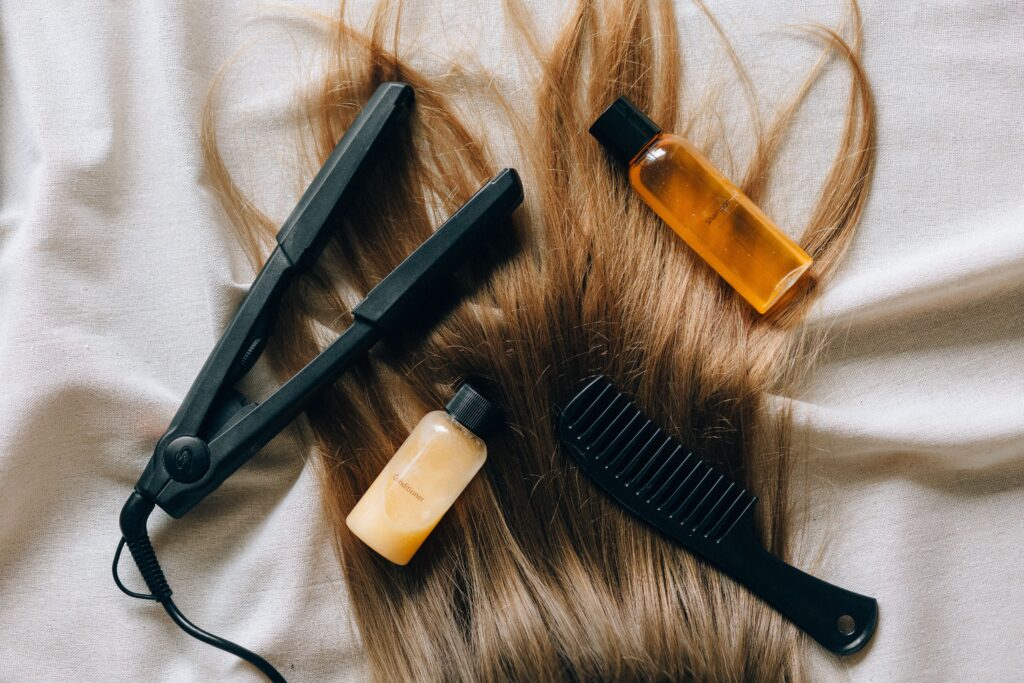
Too much heat from a flat iron, curler, hot comb or other heat styling tool is the most cited reason for the smell of burning hair. That is because these tools directly apply extremely high heat to the hair shaft, rather than diffusing warm air like most hair dryers. A flat iron applies heat through the plates themselves.
Experiments show that a hot flat iron can do real damage to the hair keratin.
One study on hot flat ironing showed protein modification, keratin decomposition, decreased water-holding ability, and increased breakage following thermal stress. Every time you use a straightener, it won’t damage your hair. Depends how often you use it and what the heat and duration of contact is, as well as the texture of hair and whether any chemical processing had already been applied to the hair.According to the American Academy of Dermatology flat irons should be used only on dry hair and on a low or medium temperature setting as overheating can severely damage the hair.
A particularly important warning sign
If you can smell burning while the styling tool is touching your hair, do not treat the smell as evidence that the tool is working effectively.
A stronger smell does not mean better straightening or curling. It can indicate that the hair or a product on it is being overheated.
2. Styling Products Can Smell Burnt When Heated
Hair products and high heat aren’t a good combination. The smells you notice might be your products. Products with ingredients that readily burn contain alcohol, essential oils, or other chemicals when exposed to enough heat, they start to break down and that process releases an odor.
Products vary widely.
Whether you use oils, heat protection creams, serums or sprays-different ingredients behave differently, releasing aromas differently. That can also explain why the same heat setting from a straightener could smell differently on two peoples hair. So a burnt smell does not by itself mean extreme and rapid highheat damage has occurred at the fiber’s core. However, loading up on product then applying excessive heat to it is still ill-advised.
In most cases American Academy of Dermatology suggests that applying heat-protection product can be useful in minimizing heat damage, but high-level of heat should still be moderated, and too much heat protection can itself cause the smell if it’s filled with too much and is heated at extreme temperatures.
If the smell seems associated with one or another’s particular products after a straightening or styling session, you may have found culprit.
3. Repeated Heat Styling Can Gradually Damage the Hair
Sometimes there is no single incident that explains the smell. Instead, the problem develops after repeated use of heated styling tools.
Repeated thermal stress can affect the hair cuticle, the outer protective layer, and the cortex, which provides much of the hair fiber’s strength and structure.
Laboratory studies have demonstrated that repeated heat treatment can produce structural changes, including cracks and other alterations in the hair fiber.
Over time, heat-damaged hair may become:
- Dry or rough
- Frizzy
- Less shiny
- More prone to tangling
- Easier to break
- More difficult to style
- More susceptible to split ends
A burnt odor appearing alongside several of these changes is more concerning than a brief smell after a single styling session.
The American Academy of Dermatology similarly notes that excessive heat can leave hair brittle and damaged and recommends reducing heat exposure.
4. Your Hair May Already Be Chemically Damaged
Bleaching, coloring, relaxing, perming, and chemical straightening can alter the structure of the hair shaft.
Chemically processed hair may respond differently to heat than untreated hair because previous processing can make the fiber more vulnerable to additional stress.
Research examining chemical straightening has found associations with hair-shaft damage, changes in hair structure, scalp irritation, and hair loss, although the degree of damage varies between techniques and products.
This creates an important cumulative effect.
For example, someone may bleach their hair and then frequently use a high-temperature flat iron. Neither process necessarily has to produce dramatic damage immediately. Together, however, they can place considerably more stress on the hair fiber.
If your hair began smelling burnt after bleaching, relaxing, coloring, or chemical straightening, it is sensible to reduce additional chemical and thermal processing rather than trying to cover the smell with another product.
5. Wet or Damp Hair May Be Getting Overheated
Heating wet hair even if you use dry hair tools makes it extremely difficult because the trapped water either in or around the hair could instantly heat and turn into a steam vapor. Hair appliances are to be generally used with dry hair unless your gadget specifically has a wet-to-dry operation. The American Academy of Dermatology said flat irons are to be only used for dry hair and further recommended minimizing on a high level use of the heating instruments of such appliance.
The sizzling is an absolutely practical alert – you hear the sound?
Then you better continue doing it to wait till you’re done putting it all to dry to then continue doing it to a regular type of iron. Not to be compared with that of blowing your hair through it; using a regular blow dryer when you got damsel tress is ok cause you can effectively remove the water from the strands through it in motion. It’s the use of intense direct heat to strands of hair while they’re soaking wet.
6. Product Buildup May Be Contributing to the Odor
Your hair may have residue build-up from oils, dry shampoo, styling cream, spray, gel and other styling product. If your hair is repeatedly styled without being thoroughly cleansed, this product build-up may alter the scent of your hair and when heat is later applied, heat may amplify the smell of the product. This is not to say the build-up is harming your hair like heat damage does.
However, it is one more way the newly styled hair may have an unusual odor.
Look at your entire routine. If the smell only appears after a few days of using a lot of product and styling properly washing your hair may fix the issue properly washing your hair may fix the issue. Don’t over-aggressively scrub your hair and scalp to get rid of the smell, as too much friction will further physically damage your hair.
7. A Hair Dryer Can Also Cause a Burnt Smell
Everyone fixates on flat irons for heat damage but blow dryers can play a role in heat damage too. Heat applied to your hair from your blow dryer depends on how hot your dryer is, how close it is to your head, how much it’s blowing, how much you move it around, and how long you dry your hair. Studies were run on the drying process of hair and high heat correlates to surface damage.
Additionally, how the hair is dried affects damage done to it as well.
So, drying one section for a really long time with the dryer placed incredibly close to it is not the same as walking the dryer back and forth with a safe distance kept. For better heat safety with your dryer, try giving your hair a chance to air dry partially or cut back on blow drying it frequently – the American Academy of Dermatology offers that guidance.
8. A Chemical Straightening or Smoothing Treatment May Be Responsible
Pay attention to any smell that seems burnt or irritating during or after a salon smoothing treatment.
A burning, irritating smell can mean that certain chemical straightening/smoothing products are producing chemicals that are irritating when heated. Studies on professional hair smoothing procedures have documented formaldehyde exposure from certain products and heating procedures.
This doesn’t mean all keratin treatments and smoothing procedures contain formaldehyde or release dangerous levels of it. Some products and formulas vary extensively.
But, if you smell strong chemicals, have irritation in the eyes, start coughing, difficulty breathing, scalp burning, etc., while you’re having the treatment, leave the immediate area and consult a professional (stylist or a doctor).
Do not assume something advertised as “formal dehyde free” actually poses no problem, as formulations and labels vary by region and there can be chemicals that release formaldehyde in certain situations.
How to Tell Whether Your Hair Is Actually Heat Damaged
The smell alone cannot tell you exactly how much damage has occurred.
Instead, look at the condition of the hair after the smell appears.
Signs that suggest heat damage
Over-baked, heat-damaged hair might be unusually brittle, frizzy, coarse, or split. Color change and splits might be telling more than odor, though. “Studies shows thermal damage can result in both surface and interior hair structure damage, dependent on the amount of heat and time,” explains Oriba.
Lastly, elasticity.
“Severely stressed hair breaks, pulls and splits while being handled and brushed,” Oriba notes. But you can’t observe microscopic shaft damage from your bathroom mirror at home. If you’re seeing a lot of splitting and breakage (with nothing else to blame, like a sudden loss of color), a dermatologist can tell if there’s shaft damage or if something more serious is going on in the roots or the scalp.
Burnt Smell vs. Burned Scalp: Why the Difference Matters
Smells: It is not a burning sensation from hair you are smelling it is an actual burn on the skin of your scalp. Hair is a dead product once it is above your scalp, but your scalp has living skin that can be burned from extreme heat. So if a hot styling appliance came in contact with your scalp, you would feel the burn which would cause a red burned mark, or a blister on your scalp.
You would experience burning, it would also swell up and blister.
If you get those symptoms it is not a hair styling and it is an injury. Scalpache, scaling of the scalp, redness or inflammation after a chemical treatment should not be considered normal discomfort. There are case studies of chemical relaxers and straightenings causing burns of the scalp, in literature so the medical attention can be seeked.
Does a Burnt Hair Smell Mean Your Hair Is Ruined?
No.
That temporary burnt smell isn’t a sign that the entire head is now irreparable. “Hair damage occurs on a spectrum, not on/off” wrote a writer over at XoJane recently regarding a similar incident. A single application of too much heat probably won’t wreak much visible havoc.
On the other hand, consecutive applications could certainly cause the entire hair shaft to “degrade over time.”
As hair writer, Ashley Graham of “2 Reasons I Stopped Using Shampoo…” advised, it “ really boils down to what happens after.” If the burnt smell fades and the hair continues to look and feel relatively normal: you most likely did no permanent damage. If the smell persists and the hair feels course, is breaking or splitting or has entirely different texture: don’t blast it with anymore heat. Because damage can’t really be reversed, the most care products can do is make that damaged section appear (and function as) the least awful as possible.
For hair bloggers that means you need to exercise serious caution on products that claim to “repair” it because “your hair doesn’t have a living cell to its name to repair itself.”
What to Do If Your Hair Smells Burnt
Instead of try to “ deodor” the burn smell, eliminate the source of the problem is the primary way to combat it.
Let the hair cool. If heat styling has been accompanied by excessive residue (products, dirt, and grime), wash hair in a formula fit to your specific type with shampoo and conditioner. Don’t immediately run to “ fix” damage by applying heat and then another product-wait for the next two to four sessions to apply heat. “ During your next two to four sessions with a styling iron/wand, lower the temperature used,”“The American Academy Dermatology does advise using low heat on a straightiron / Wand and minimizing using of flatirons and wands and that means not over use.
“Some product has heat damage on products,” said Deon Stewart, a freelance cosmetology and Makeup and Hair Stylist inAtlanta.“Heat protectants offer some protection, but they do not completely block heat damage. The goal is to create a culture of avoiding excessive heat on the hair,” Stewart continued. Some people if their hair has been through so much that sometimes we got to step back and let the hot one grow so, what we can go to more low manipulation hair styles on that for so on so the on you get back to, all your healthy hair growth.”
How to Prevent Your Hair From Smelling Burnt Again
Prevention means controlling heat, time of contact, frequency, and chemical dosage throughout time. Heat the lowest temperature that can create your style. Don’t draw your heated tool through a single piece of hair twice.
Always start your conventional flat ironing on completely dry hair.
Space high heat styling days rather than beating your hair with high temperatures everyday. AAD’s Advice: Minimize flatiron use. Heat hair on low/medium. Use the blowdryer less.
What’s more, you might even want to review how the rest of your routine stacks up.
Bleach all of your hair, and chemically relax it all too… and color it regularly while you’re heat styling the top all the time… naturally your hair doesn’t have as much resilience to heat exposure as a head of hair, only one of these treatments a day. Hair damage is cumulative, really, not the product of one specific action.
When Should You See a Dermatologist?
That “singed smell” right after a hot styling tool is rarely a medical emergency, though it is an indication to ramp up your hair routine, especially If your scalp still burns long after using an iron, develops redness, itchiness or anysores – if you have a serious skin problem and skin care is in question, go see dermatologist, your best friend The American Academy of Dermatology’s advice is to visit a board certifiedermatologist for any hair related questions as it has the most training and expertise in both hair conditions and the hair loss, If you get a chemical procedure and begin to have difficulty breathing or eye problems, you might want to reconsider continuing.
Common Misunderstandings About Burnt-Smelling Hair
“If it smells burnt, my hair must be burning.”
Not necessarily. The odor can come from heated styling products or residue as well as thermal changes in the hair itself.
“Heat protectant means I can use any temperature.”
No. Heat-protective products may reduce certain types of damage, but they do not eliminate the effects of excessive temperature or prolonged exposure.
“The higher the temperature, the better the style.”
Higher temperatures may make styling faster, but excessive heat increases the potential for hair damage. Dermatologists recommend lower or medium settings where possible.
“I can repair burned hair completely with a conditioner.”
Conditioning can improve feel, lubrication, manageability, and appearance. It cannot restore hair fibers that have already suffered irreversible structural damage.
“Only flat irons cause burnt hair.”
No. Curling irons, hot combs, blow dryers, and heated chemical treatments can all expose hair to substantial thermal stress.
Conclusion
So, why does my hair smell burnt?Excessive heat from a flat iron, curling iron, hot comb, or blow dryer (although heated styling products, product buildup, chemical treatments, and already compromised hair could play a role), is typically responsible. According to research, enough (or too much) heat exposure can affect keratin, make the cuticle and cortex brittle, affect moisture retention, and cause an increase in hair breakage. Your “burnt hair” scent, then, serves best as an indicator that your hair habits need to be checked (and ideally amended) and not merely camouflaged with a perfumed spritz.
Lower heat usage, less frequent going over of the same section with hot tools, better heat protection and, in the case of processed hair, spacing out aggressive treatments can be key.
Of course, if this smell coincides with significant breakage, a burning scalp, itching or loss, professional attention is warranted for more serious damage.
8. FAQs
1. Why does my hair smell burnt even after washing it?
If the smell persists after washing, the hair may have experienced thermal damage, or residue from repeated styling and chemical treatments may still be contributing to the odor. Persistent smell combined with roughness or breakage is more suggestive of significant hair damage.
2. Can a flat iron make your hair smell burnt?
Yes. High-temperature flat irons can thermally alter hair keratin and damage the hair shaft. The smell can also come partly from products applied before straightening.
3. Why does my hair smell burnt after blow-drying?
A high heat setting on the dryer, holding the dryer too close, drying for too long or the use of heat-styling appliances can create smell. It has been found that increased drying heat can lead to a greater increase in the surface damage of the hair.
4. Can burnt-smelling hair grow back healthy?
Any new growth from the follicle will not be at all damaged, even just because existing growth was overheated. However, length that is damaged will remain that way until it is cut off and/ or grown out.
5. Does heat protectant prevent all heat damage?
No. Thermal protectants can minimize some of the damaging effects of heat, but they will not completely eliminate it. Temperature, duration of exposure, and how often you use it all still contribute to hair damage.
6. Why does my hair smell burnt after a keratin or straightening treatment?
The smell can be caused by the chemicals, ingredients being heated during the treatment process. Professional smoothing treatments were reported to give off formaldehyde during heating, so a strong chemical smell or irritation should not be disregarded.
7. Should I stop using heat if my hair smells burnt?
If you also have brittle or broken hair that splits more than normally. You may want to reconsider your styling routine and temporarily avoid or limit high heat use. Try giving it a chance to breathe and recover.