A growing number of people search for gone wrong buccal fat removal smile after noticing unexpected changes in their facial expressions following surgery. While buccal fat removal is designed to create a slimmer, more sculpted appearance, some patients become concerned when their smile looks uneven, tighter than before, or simply different from what they expected.
In many cases, the alterations you experience will be transient, as the body heals. Such temporary limitations in smiling could be due to temporary swelling, tissue stiffness or even inflammation following the first few weeks after surgery. However, in a small number of cases, lasting smile alterations could signify nerve compression, a bit of over-suctioning, scar tissue development or a different complication that warrants evaluation by your surgeon. Knowing whether your smile issue is part of the normal recovery process versus a real complication can enable you to make a more informed decision without unnecessary alarm.
What Is Buccal Fat Removal?
Buccal fat removal is a cosmetic surgical procedure performed to reduce fullness in the lower cheeks.
Inside each cheek lies a naturally occurring pocket of fat known as the buccal fat pad. The size of this fat pad varies significantly from one person to another. Individuals with naturally fuller cheeks may choose surgery to create a more defined facial contour.
During the procedure, the surgeon makes a small incision inside the mouth, carefully exposes the buccal fat pad, and removes a measured amount of fat before closing the incision with dissolvable sutures.
Because the incision remains inside the mouth, visible facial scars are typically avoided.
The goal is subtle contouring not dramatic hollowing while preserving a natural facial contour.
Why Do People Search “Gone Wrong Buccal Fat Removal Smile”?
Most people considering the procedure focus on before-and-after photos showing slimmer cheeks. Fewer people realize that the cheeks play an important role in facial movement, especially when smiling.
After surgery, patients may notice:
- Their smile feels tighter.
- One side moves differently.
- Their cheeks appear hollow.
- Their face looks older than expected.
- Facial expressions seem less natural.
These concerns often lead people to search gone wrong buccal fat removal smile, wondering whether their experience represents normal healing or an actual complication.
How Buccal Fat Removal Can Affect Your Smile
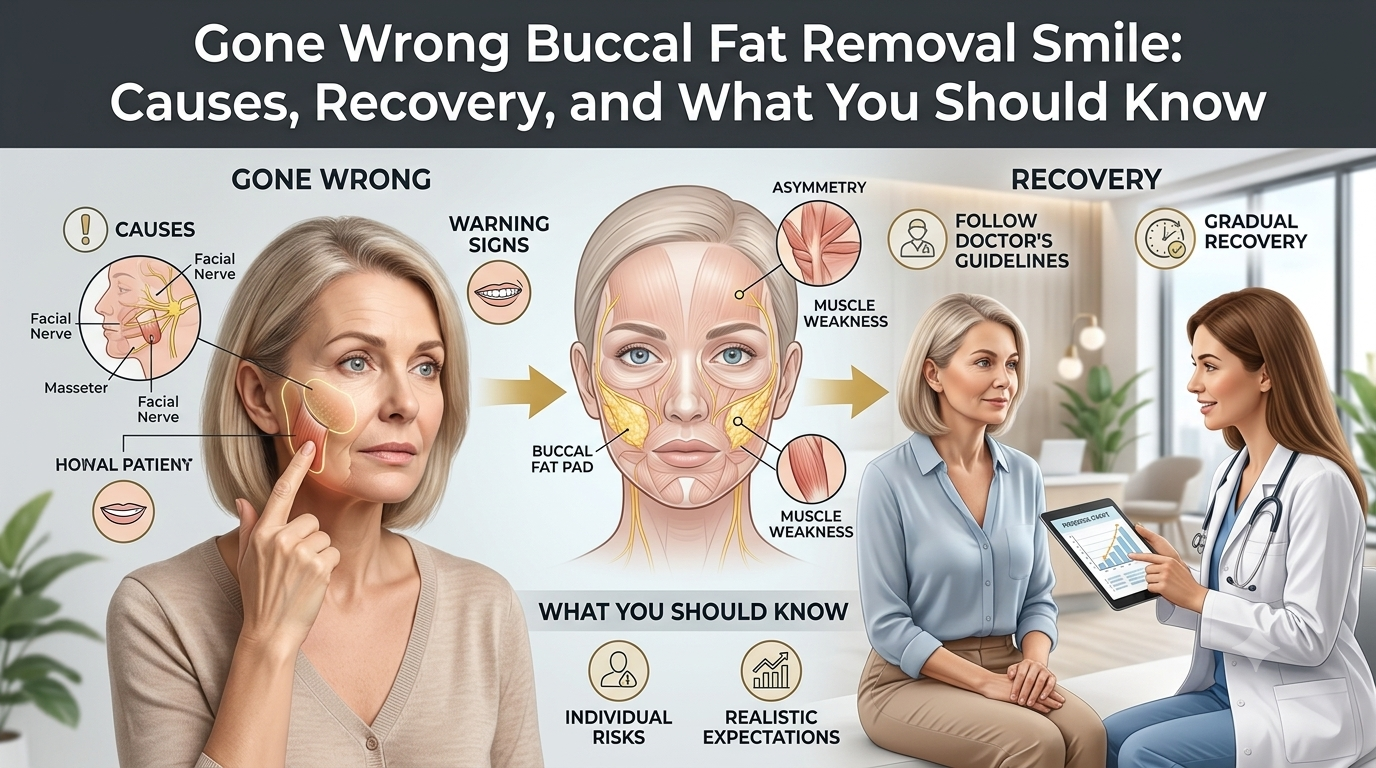
The cheeks are more than simple fat deposits. They contain muscles, connective tissue, facial nerves, blood vessels, and supportive structures that all contribute to facial expression.
Although buccal fat itself is not responsible for smiling, surgery in this area occurs close to structures involved in facial movement.
As the tissues heal, temporary stiffness and swelling may change the appearance of a smile.
Most patients gradually regain their normal facial movement as inflammation resolves.
However, the final appearance depends on several factors, including:
- Individual anatomy
- Surgical technique
- Amount of fat removed
- Healing response
- Scar tissue formation
Understanding these variables helps explain why results vary from person to person.
Normal Healing vs. Signs Something May Be Wrong
Many patients become worried within the first few days after surgery.
Fortunately, early changes are often expected.
The table below highlights the difference between normal recovery and symptoms that may require medical evaluation.
| Normal Recovery | Possible Complication |
| Mild swelling | Increasing swelling after initial improvement |
| Temporary tight smile | Persistent facial weakness |
| Mild bruising | Significant asymmetry months later |
| Limited facial movement due to swelling | Difficulty moving one side of the mouth |
| Tenderness | Severe pain or signs of infection |
This comparison is only a general guide. Individual recovery varies, and concerns should always be discussed with the treating surgeon.
Common Causes of a Gone Wrong Buccal Fat Removal Smile
Several factors can contribute to unexpected smile changes after surgery.
Temporary Swelling
The most common explanation is swelling.
Inflammation affects surrounding tissues, making the cheeks feel firm and less flexible.
As swelling decreases over several weeks, facial expressions often become more natural.
This temporary phase is one of the most frequent reasons patients mistakenly believe something has gone wrong.
Internal Scar Tissue
Healing naturally produces scar tissue.
Although most internal scars soften with time, excessive scar formation can occasionally create tightness inside the cheek.
This may temporarily influence facial movement or create the sensation that smiling requires more effort.
Uneven Fat Removal
Facial symmetry is never perfectly identical.
If different amounts of buccal fat are removed from each side, subtle asymmetry may become more noticeable.
Experienced surgeons carefully evaluate facial proportions before removing tissue to reduce this risk.
Over-Removal of Buccal Fat
One of the most discussed concerns is excessive fat removal.
Removing too much fat may create:
- Hollow cheeks
- A gaunt appearance
- Reduced facial softness
- Increased visibility of facial aging
Since facial fat naturally decreases with age, overly aggressive removal may become more noticeable years later.
This is why many surgeons now emphasize conservative contouring rather than dramatic reduction.
Temporary Nerve Irritation
Several branches of facial nerves travel near the surgical area.
Although permanent nerve injury is uncommon when surgery is properly performed, temporary irritation may occur because of swelling or surgical manipulation.
Symptoms may include:
- Temporary weakness
- Altered facial movement
- Uneven smile
- Mild numbness
Many cases improve gradually as healing progresses.
Can Buccal Fat Removal Permanently Change Your Smile?
This is one of the questions patients ask most often.
In most cases, your smile is not affected because the procedure targets the buccal fat pad rather than the muscles responsible for facial expressions.
However, a smile may appear different because the surrounding facial volume has changed.
Think of it like removing padding beneath fabric.
The structure remains the same, but its appearance changes.
A slimmer cheek can alter how light reflects across the face and how facial contours look during expressions.
For some people, this creates a more sculpted appearance.
Others may feel the change looks less natural than expected.
Facial Anatomy: Why Surgical Precision Matters
Successful buccal fat removal requires a detailed understanding of facial anatomy.
Several important structures lie close to the surgical field.
Facial Nerves
Branches of the facial nerve control muscles responsible for smiling, speaking, and other facial expressions.
Protecting these structures is a major priority during surgery.
Salivary Ducts
The parotid duct transports saliva into the mouth.
Accidental injury can create complications that require medical treatment.
Blood Vessels
Careful surgical technique minimizes bleeding while preserving healthy circulation.
Facial Muscles
Although the muscles themselves are generally not removed during buccal fat reduction, surrounding tissues should be handled gently to support normal healing.
The complexity of this anatomy explains why buccal fat removal should only be performed by qualified professionals with appropriate surgical training.
Who Is More Likely to Experience Unsatisfactory Results?
Not every face benefits equally from buccal fat removal.
Certain individuals may face a higher risk of disappointing cosmetic outcomes.
Naturally Thin Faces
People with naturally lean facial features may lose too much volume after surgery.
As they age, facial fat naturally declines further, potentially making hollowing more noticeable.
Older Adults
Aging already reduces facial fullness.
Additional fat removal may exaggerate age-related volume loss.
For this reason, surgeons often evaluate skin quality and existing facial volume before recommending surgery.
Individuals Seeking Dramatic Changes
Patients expecting an extreme transformation may be disappointed because buccal fat removal is designed to create subtle contouring rather than completely reshape the face.
Realistic expectations remain one of the strongest predictors of satisfaction.
Patients Choosing Inexperienced Providers
Technical skill significantly influences surgical outcomes.
Accurate assessment of facial anatomy, conservative fat removal, and balanced contouring all require experience.
Choosing a qualified surgeon helps reduce the risk of asymmetry, over-resection, and other avoidable complications.
Common Misconceptions About Buccal Fat Removal
Myth: Every Different Smile Means the Surgery Failed.
Early swelling commonly changes facial expressions.
Final results often cannot be judged for several months.
Myth: Buccal Fat Removal Always Causes Premature Aging.
Not necessarily.
Conservative fat removal in appropriately selected patients may produce balanced results.
Problems are more likely when excessive fat is removed or the procedure is performed on someone with limited facial volume.
Myth: Recovery Ends in One Week.
While discomfort often improves quickly, internal healing continues for several weeks, and the final facial contour may take several months to develop.
Myth: Online Before-and-After Photos Tell the Whole Story.
Lighting, camera angles, facial expressions, and the stage of healing can all have a significant impact on how the results appear.
Individual results vary based on anatomy, surgical technique, and recovery.
Expert Perspective
Facial plastic surgeons increasingly emphasize a conservative approach to buccal fat removal. Instead of removing large amounts of fat to create dramatic cheek hollows, many now focus on preserving facial balance and long-term harmony.
One important consideration is that facial aging naturally leads to volume loss over time. Removing too much buccal fat in younger years may contribute to a hollow or gaunt appearance later in life. For this reason, careful patient selection, precise surgical technique, and realistic expectations are essential for achieving satisfying, natural-looking results.
Can a Changed Smile Be Fixed?
One of the first questions patients ask after noticing an uneven or unnatural smile is whether it can be corrected.
The answer depends on why the smile changed in the first place.
If swelling or temporary nerve irritation is responsible, improvement often occurs naturally as the tissues heal. In these situations, patience is just as important as proper follow-up care.
However, if the change results from excessive fat removal, significant asymmetry, or scar tissue that limits movement, additional treatment may be necessary. A thorough examination by the original surgeon—or a qualified facial plastic surgeon for a second opinion—can help determine the underlying cause and discuss realistic treatment options.
Treatment Options for Unsatisfactory Results
There is no single solution for every case of a gone wrong buccal fat removal smile. Treatment depends on the specific problem identified during evaluation.
Observation During Healing
Many concerns resolve without additional procedures.
Most surgeons recommend allowing sufficient time for swelling to subside before judging the final outcome. Facial tissues continue to settle over several months, and what initially appears uneven may gradually improve
Scar Tissue Management
If internal scar tissue contributes to tightness or restricted movement, the surgeon may recommend conservative management while the tissue matures.
In selected situations, additional treatment may be considered if symptoms persist after healing is complete.
Facial Volume Restoration
When excessive fat removal creates unwanted hollowness, restoring facial volume may help improve facial balance.
Depending on the individual’s needs, options may include procedures designed to replace lost volume. The appropriate approach should always be discussed with an experienced facial plastic surgeon after a comprehensive evaluation.
Revision Surgery
Revision surgery is generally considered only after complete healing and when a correctable structural issue has been identified.
Because secondary facial procedures can be more complex than the original operation, they require careful planning and realistic expectations.
Recovery Timeline: When Should You Expect Improvement?
Healing after buccal fat removal is gradual.
The timeline below provides a general overview, although individual recovery varies.
| Time After Surgery | What You May Experience |
| First few days | Swelling, mild discomfort, limited facial movement |
| Week 1–2 | Bruising begins to improve, swelling gradually decreases |
| Weeks 3–6 | Smile often feels more natural as tissues soften |
| 2–3 months | Facial contour becomes more defined |
| 3–6 months | Final cosmetic result is usually easier to evaluate |
Patience is important because judging results too early can lead to unnecessary worry.
When Should You Contact Your Surgeon?
While mild swelling and temporary tightness are expected, certain symptoms should prompt medical evaluation.
Contact your surgeon if you experience:
- Rapidly increasing swelling
- Persistent facial weakness
- Difficulty moving one side of the mouth
- Fever or signs of infection
- Severe pain that continues to worsen
- Pus or unusual drainage from the incision
- Significant asymmetry that does not improve over time
Early assessment allows your healthcare provider to determine whether the healing process is progressing normally or if additional treatment is needed.
How to Reduce the Risk of Poor Buccal Fat Removal Results
Although every surgical procedure carries some degree of risk, thoughtful planning can significantly improve the chances of a satisfying outcome.
Choose a Qualified Surgeon
Experience plays a major role in facial cosmetic surgery.
A surgeon with specialized training in facial anatomy is better equipped to preserve natural facial balance while minimizing unnecessary tissue removal for a more Gone Wrong Microneedling.
Have Realistic Expectations
Buccal fat removal is designed to refine facial contours—not completely change facial structure.
Patients who expect subtle enhancement are generally more satisfied than those expecting dramatic transformation.
Follow Postoperative Instructions
Recovery instructions are provided for a reason.
Following recommendations regarding oral hygiene, diet, activity restrictions, and follow-up visits supports proper healing and reduces unnecessary complications through proper post-surgical recovery care.
Allow Enough Time for Healing
One of the most common mistakes is judging results too soon.
Swelling may temporarily make the face appear uneven or alter the appearance of a smile. Waiting until healing is complete provides a much more accurate picture of the final result.
Expert Insights
Facial cosmetic surgery has come a long way; from creating a totally carved appearance to restoring the natural proportion of the face. Many facial plastic surgeons are now choosing a conservative approach for buccal fat removal because the presence of fat volume makes the face look younger. Too much of buccal fat removal may give a more chiseled face at first glance but might actually result in an aged appearance with loss of volume as the facial skin starts drooping over the years.
Surgeons agree that a perfect smile cannot be the result of fullness of cheeks only.
The facial muscles, skin elasticity, bone structure of the face and overall harmony of the face are just as responsible in determining how the expressions look postoperatively. This change of attitude toward a holistic perspective has lead to a more personalized approach wherein surgeons assess the candidacy of the patient before recommending buccal fat removal and not as a generalized facial cosmetic procedure.

Frequently Asked Questions
1. Is it normal for my smile to look different after buccal fat removal?
Yes. Swelling, internal healing, and temporary tissue stiffness can make your smile appear different during the early recovery period. In many cases, facial movement improves as healing progresses.
2. Can buccal fat removal permanently damage facial nerves?
Permanent nerve injury is uncommon when the procedure is performed by an experienced surgeon. Temporary nerve irritation may occur but often improves with recovery.
3. How long does it take for my smile to return to normal?
Many people notice gradual improvement within several weeks, while the final facial appearance may continue developing for several months.
4. Can too much buccal fat be removed?
Yes. Over-removal may contribute to hollow cheeks or an overly thin facial appearance. This is why many surgeons prefer a conservative approach tailored to the individual’s facial anatomy.
5. Can a poor cosmetic result be corrected?
Some concerns improve naturally with time, while others may require additional evaluation or treatment. The most appropriate option depends on the specific cause of the unsatisfactory result.
6. Who is not an ideal candidate for buccal fat removal?
People with naturally thin faces, significant age-related facial volume loss, or unrealistic expectations may not be ideal candidates. The best way to find out if you’re a suitable candidate is through a personalized consultation.
7. When should I worry about an uneven smile after surgery?
If facial weakness, significant asymmetry, or difficulty moving one side of the mouth persists or worsens after the expected healing period, you should contact your surgeon for an evaluation.
Conclusion
What Causes the buccal fat removal smile?
This type of concern likely arises from worries regarding changes in how a patient smiles after surgery. An unfamiliar facial expression can be alarming, but keep in mind that changes in facial movement are common in the first few weeks following recovery, due to swelling, stiffness of the tissue, and natural healing.
None of these issues signify a botched surgery.
If your problems continue to persist beyond the healing process, however, the procedure warrants medical attention. Whether over-excision of fat, asymmetric recovery, scarring or the rare complications occur, they will likely warrant revision procedures or additional watchful care. Knowing when a change is due to healing or is a complication, is vital for patients trying to navigate the plethora of information online to understand whether they truly need to worry or not. Successful buccal fat removal relies on careful patient selection, reasonable expectations, conservative operative decisions, and the right surgeon.