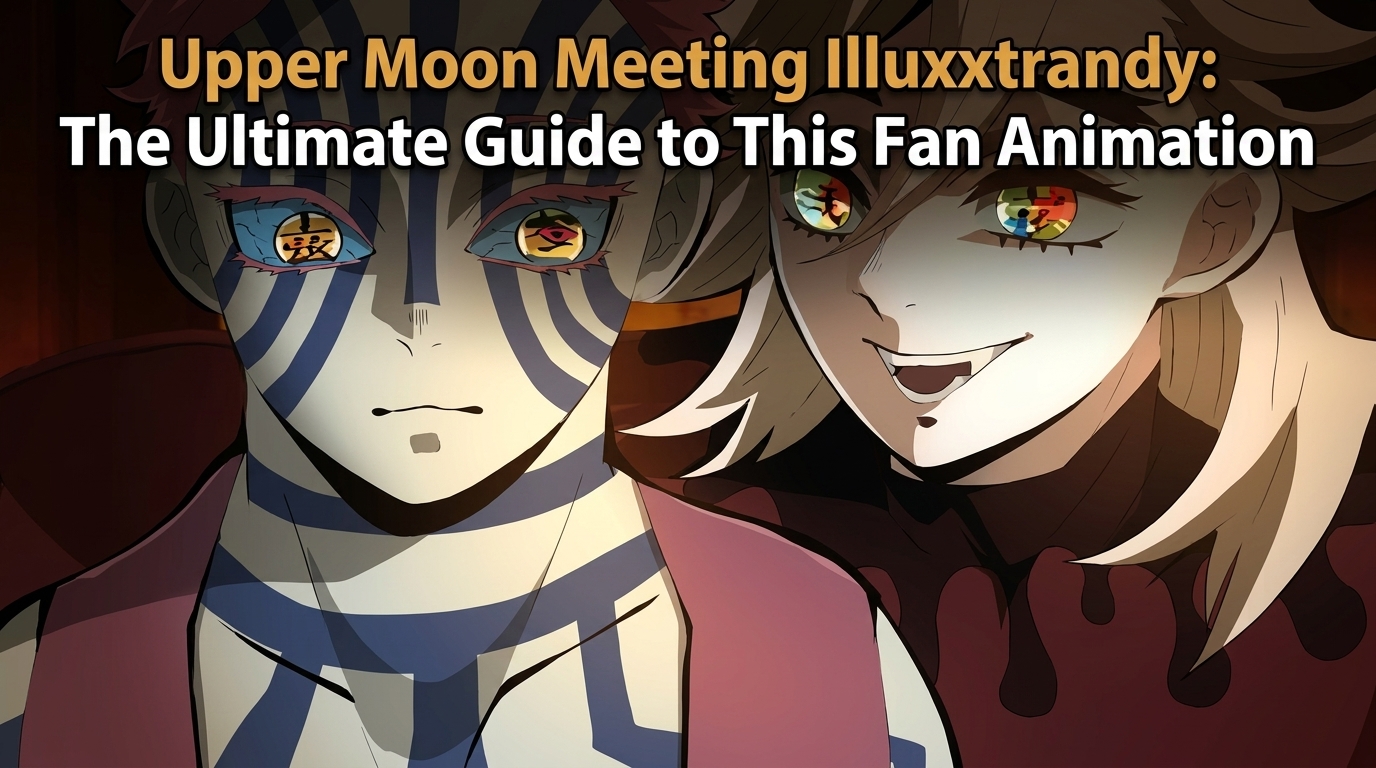
The search query “upper moon meeting illuxxtrandy” refers to a fan animated video related to a certain creator named Illuxxxtrandy based off one of the more memorable meetings in the Demon Slayer: Kimetsu no Yaiba series. The specific scene that is being depicted is the Upper moon meeting taking place within the Infinity castle after the death of Upper Moon Six is announced.
This distinction is important due to the fact that this animated scene by Illuxxxtrandy is not a part of the official animation for Demon Slayer, a movie, or any new animated scene put out by the Demon Slayer animators, as stated by indexed sites they’ve only worked with Illuxxxtrandy on animated projects posted through their social media; and not on the scene.
Knowing the difference between the fan animation and the scene the search query is based off can aid you in comprehending why a query that might be very obvious after realizing the distinction would also garner such interest when the original scene is a highly recognizable scene and the Infinity Castle setting, and creators can make very interesting animations!
What Is the Upper Moon Meeting?
The upper moon meeting, in short, involves all the top strongest demons under muzan kibutsuji in the manga, and it take place in the anime just after Upper six Daki and gyutaro were defeated. To fans of the show this a vital since this the very first major instance where many of the upper moon demons are visible at once. And instead of showing each of their powers or personalities through conventional exposition, the meeting allows viewers to glimpse them interact in their own element.
The opening to the third season in “Someone’s Dream,” features the upper ranks meet in the Infinity Castle arc following the last two’s defeat.
Right then, we find that the ultimate question of this scene: What happens when all of the individually badass characters find themselves in one room with each other. The answer isn’t cooperation exactly. The meeting shows that the ranks are founded by a hierarchy built around strength, fear,status and the command of muzan himself.
Where Illuxtrandy Fits Into the Scene
The Illuxtrandy animation bases the canon material as a reference instead of a substitution. The creator’s account on the relevant social media platform is able to cite a post indexing the animation as part of its promotional material, with tags referencing Demon Slayer, Kokushibo, and the creator’s persona. The creator’s account also made indexed posts for a countdown until the animation’s release, which means that it was built and promoted in advance and as a standalone, fan made animation.
The creator’s social media also shows that the animation received quite a lot of engagement.
One indexed post connected to the animation can report an estimated 200k views and a number of thousands of likes; a promotional post about the animation earned well over one million views. The preceding view counts do not come from the platform analytics, but from a social media mirroring source, thus the viewer numbers and likes should be interpreted as reports of engagement rather than a definitively audited stat. The distinction for people exploring the keyword is that Illuxtrandy is not responsible for the original creation story for Demon Slayer but its fan-made extension on an Upper Moon Meeting.
Why the Original Upper Moon Meeting Matters
The scene functions because it communicates all sorts of information with no exposition. There isn’t a group of antagonists because all the Upper Moons have the exact same personality goals. Instead, they appear as their individual styles as it comes to authority and power.
Kokushibo, number 1, is in charge via discipline, military-style structure, and strength he can not ignore.
While his number #2, Doma – behaves much… in line with standard-pleasures that make it rather discombobulating a being in his place could act that relaxed socially, in a happy bubbly kind of way, whereas number 3 Akaza is very antagonizing. In fact, his beef with Doma may very well be the scene’s most significant narrative contribution. And, since #4, and #5 Hantengu, and Gyokko are both just too quirky for us to deal with (though in vastly different ways,) and #6 was occupied by siblings Daki and Gyutaro not really worth acknowledging here as a new element- this scene does more than merely set up these new and unique personalities. This scene does introduce the pecking order of demons.
The Akaza and Doma Conflict Is Central
“Another aspect I like is the encounter between Akaza and Doma. Their conversation at the start might look like friendliness, but Akaza is visibly not so into it. Before we know it they are beating up each other, so as the Upper Moons the’d still never really be best friends despite having the same master.
The meeting also gives a great insight to how their rankings work.
Whatever strength you have you got a level, and they knew where they fell on that line. Kokushibou turning up reinforces all of that. They knew he was one a higher tier than himself, his power wasn’t only symbol or some sort of indication of his status.” -Fan Animator Comment via Quote I’m also glad this scene is so ripe for fan animation. There’s a tension in the scene well before we see even further major plotting.
The Wiki article where they summarize the scene also makes the great comparison to the Hashira meetings vs the Upper Demon level; the Hashiras had their loyalty and mutual respect amongst themselves and the Master whereas The Hashiras’ Master (Muzan) commanded much more due to fear he imposed on them.”
The Infinity Castle Makes the Meeting Visually Distinct
The location is almost as important as the characters.
Infinity Castle defies linear logic, with rooms, stairs, platforms, corridors, and shifting viewpoints contorting into an impossible space where common notions of distance and direction are less meaningful. But the architecture offers a unique framing opportunity for the animation, however. Whereas a normal meeting scene between demons would have characters grouped in a room, around a table, or some similar layout, Infinity Castle flips the convention.
A character could appear on an adjacent floor, be the approach from any direction, and be on different horizontal planes entirely as immense verticall space divides them.
That spatial language drives home the Upper Moons exist in a world dominated by Muzan and Nakime, and they are all very small, insignificant in their individual lives. Such an impressive visual structure for this moment also partially explain why fan animations of this scene can be very dramatic in their visual scope. After all, there is a great deal of dramatic, surreal architecture to begin with as well as unusual movement and staging of characters in space.
Why “Illuxtrandy” Is Part of the Search Intent
Someone searching for “upper moon meeting illuxtrandy” is probably not looking only for an explanation of the anime scene.
The addition of “Illuxtrandy” changes the intent.
It suggests that the searcher may be looking for:
- the fan animation itself
- information about its creator
- an explanation of what happens in the animation
- the characters featured in it
- whether the animation is official
- the connection between the animation and Demon Slayer
- visual or stylistic details
- related clips or promotional posts
The indexed creator posts support this interpretation. Illuxxxtrandy’s account specifically refers to the animation as “my animation Upper Moon Meeting”, and separate posts highlight Akaza and Doma from the project.
That makes the creator’s name an important part of the keyword rather than a random modifier.
Is the Illuxtrandy Upper Moon Meeting Official?
No. It should be treated as a fan animation rather than an official Demon Slayer production.
The distinction is straightforward:
| Element | Status |
| Upper Moon Meeting in Demon Slayer | Canon |
| Infinity Castle setting | Canon |
| Muzan, Kokushibo, Doma, Akaza and other Upper Moons | Canon characters |
| Original manga storyline | Official |
| Anime adaptation of the meeting | Official |
| Illuxtrandy’s interpretation | Fan-created |
| Illuxtrandy animation project | Unofficial fan work |
The indexed material explicitly associates the project with the creator’s own animation, while the official anime episode independently contains the canonical Upper Moon gathering.
This matters because fan-made animation can look remarkably polished. Visual quality alone does not make a work part of the official continuity.
What Makes the Fan Animation Interesting?
The appeal is partly based on the strength of the source material.
This even makes more sense when looking at the building materials used in the animation. All of the ingredients in Upper Moon Meeting work very well in short animation (well-defined characters, powerful rivalries, supernatural powers, striking camera options and mysterious Infinity Castle). In the case of illuxxxtrandy’s trailer, for instance, attention seems to be paid to those well-defined traits as her promotional works focused on The Upper Moon Meeting, the respective demon characters (Daki, Akaza, Doma and Kokushibo) and hashtags relating toDemon Slayer.
Illuxtrandy’s Interpretation Versus the Anime
Ultimately, I find the simplest explanation comparing the two helps highlight how different their respective roles are: The anime has the duty to perform adaptation, consistency as the primary goals. Everything its pacing, its characters motion, its dialogue, music choice, sounds, and all visuals should eventually feed into the larger work. A fan animation, then, generally has considerably more latitude for creative license.
A creator is free to zoom in on one character, alter pacing, spike one action moment, tweak camera angle, or re-frame The Atmosphere.
It isn’t required, again, to function like an entire anime episode. And that’s probably where this idea of it becoming “more focused” stems from. A fan creator will pick up on what seems like the most iconic images of a few events and emphasize them, all within a brief clip for that very purpose.
The Role of Akaza, Doma, and Kokushibo
Three characters are especially important when analyzing the Upper Moon Meeting.
Akaza
Some aspects of Akaza’s character are a direct consequence of his devotion to being strong, and Doma clearly shows him that ranking does not automatically guarantee that this devotion brings people respect in return. Akaza’s aggressive response also immediately establishes his role in the plot before the real details of his history were revealed.
Doma
Doma provides a striking contrast.
He is outwardly cheerful, conversational, and apparently friendly. Yet this behavior exists alongside his position as Upper Rank Two. The contradiction makes him unsettling.
His interaction with Akaza therefore becomes more than comic relief. It reveals how differently two powerful demons understand their relationships with others.
Kokushibo
Kokushibo is the peak on the hierarchy under Muzan. His entrance alters the mood of the meeting significantly and the others clearly recognize he’s not just a random group member. The hierarchy in this scene is vital, as it visually explains to the audience the relative importance of all the characters without needing them all described ability-by-ability.
Common Misunderstandings About Upper Moon Meeting Illuxtrandy
Do NOT always assume that any popular Demon Slayer animation circulating online is part of an official animation. That is not true. Fan artists can do extremely accurate simulations of animation because character/scene references exist based off anime production modelsheets.
Even with that, these days you get social media accounts sharing animated videos and not specifying the production.
Do NOT think all the effects/changes you might find inside that animation apply to the story in the anime, as the creator may have modified story to have them work in animation (e.g. Adding slow-downs, changing flow or interaction betweencharacters), not withthe intent of those edits becoming official.
Lastly do not be mistaken, there are numerous other “Upper Moon Meeting” fan animations other than the ones the fan animator posted, and they show up when you type “Upper Moon Meeting Demon Slayer fan animation” into google with a bunch of completely different fan made animatopm changes to the plot. That is why your animation and a given one with similar theme would depend upon who the author is that did the animation.
Why Fan Animations Matter to Anime Culture
Fan animation is more than a method of reproducing scenes, especially within anime and manga culture.
They have a chance to do something with a set of materials that have already demonstrated an audience. A franchise brings recognizable characters and a known setting, and the animator provides their own vision with their animation. Viewers are given still another chance to interact with and consume the source material.
While animation popularity doesn’t always equate to canonicity, it demonstrates that a scene can be interesting and visually or emotionally striking enough to have spawned independent creation.
The Upper Moon Meeting has the specific character qualities and atypical setting ideal for anime fan culture such inspiration.
A Better Way to Evaluate the Animation
If you want to know if the Upper Moon Meeting is worth watching, ask yourself the following questions:
Number one – is it canon? As per Illuxtrandy’s available information, this fan-made creation is not an official Demon Slayer episode but a product of the author’s imagination.
Number two – does it depict characters accurately? That depends on you and how you perceive the characters and their relationships in the original anime or manga.
Number three – what does it add to the creation beyond raw facts or the existing storyline? That is the point where the author of the video is given a chance to demonstrate their skills because animation, camera angles, acting, visual effects, editing, and music can all be used to interpret the story in a different way. Such a fan-made endeavor should be reviewed and judged as a unique work of art that expresses the author’s vision.
What the Keyword Reveals About Search Behavior
The phrase “upper moon meeting illuxxtrandy” is a useful example of a hybrid search query.
It combines:
A franchise concept: Upper Moon Meeting
A creator/entity: Illuxtrandy
A likely media format: animation
A specific fandom: Demon Slayer
This means a strong informational page should not explain only the anime scene or only the creator. It should connect both.
The reader needs to know what the Upper Moon Meeting is, why it matters, who Illuxtrandy is in relation to the animation, and whether the work belongs to official continuity.
That distinction provides substantially more value than simply repeating character names or describing the video.
Conclusion
The Upper Moon Meeting Illuxtrandy search term connects a popular Demon Slayer storyline with a fan-created animation project associated with Illuxxxtrandy. The original Upper Moon gathering is a canonical event set in the Infinity Castle, bringing together Muzan’s most powerful demon followers after the defeat of Upper Rank Six.
Illuxxxtrandy’s project is based on the recognizable property as an independent creative work. Indexed posts indicate that it was the creator’s own Upper Moon Meeting animation that received significant social-media attention.
Therefore, the most reasonable conclusion emphasizes the initial remark’s context: the Demon Slayer canon entry, independently interpreted in another author’s animation, is clearly distinguishable as such. This way, both the original and the fan production get proper recognition without confusing the audience.
FAQs
1. What is the Upper Moon Meeting in Demon Slayer?
It is a gathering of the Upper Rank demons inside the Infinity Castle after the defeat of Upper Rank Six, Daki and Gyutaro. The meeting introduces viewers to several of Muzan’s strongest followers and establishes their hierarchy.
2. Who created the Upper Moon Meeting Illuxtrandy animation?
The available indexed social-media material identifies Illuxxxtrandy (@illuxtrandy_official) as the creator associated with the fan animation.
3. Is the Illuxtrandy Upper Moon Meeting animation official?
No. The Illuxtrandy project is a fan-created animation inspired by the official Demon Slayer scene. It should not be treated as a new canon episode or official studio production.
4. Which Demon Slayer characters appear in the Upper Moon Meeting?
The canonical gathering features Muzan and the Upper Rank demons, including Kokushibo, Doma, Akaza, Hantengu, Gyokko, and the Upper Six demons in the context surrounding their defeat. The scene is particularly important for establishing the relationships among Kokushibo, Doma, and Akaza.
5. Why does Akaza dislike Doma?
Their personalities and attitudes toward strength are fundamentally different, and Akaza strongly resents Doma’s position above him. Their interaction during the meeting makes that hostility especially apparent.
6. Why is the Infinity Castle important to the meeting?
The Infinity Castle is Muzan’s supernatural stronghold and provides the meeting with an unstable, otherworldly setting. Its shifting architecture also gives the anime and fan animators unusual opportunities for dramatic visual presentation.
7. Is every “Upper Moon Meeting” animation the same?
No. Multiple fan creators have produced works using the Upper Moon Meeting concept, sometimes adding entirely original events or alternate storylines.