If you have ever wondered how to fold an envelope out of paper, the good news is that the basic idea is much simpler than it first appears. With one sheet of paper and a little attention to alignment, you can make an envelope suitable for a short note, gift card, small keepsake, cash gift, or decorative message.
It feels almost satisfying to take a perfectly ordinary piece of paper and turn it into something functional-something that requires no cutting, no glue, and no pre-packaged envelope obtained from a store. The process is almost architectural in its elegance; a flat rectangle is refashioned as a pocket, flaps pop out, and a few strategically placed creases hold it all together. If you’re wondering how to fold an envelope out of paper, this simple transformation is where the process begins.
However, the envelope as a paper folding hobby is more than an invention of the paper-craft movement. Paperfolding a sealed packet has a longer history than you might think. Before the invention of commercially made envelopes in about 1840 people routinely sealed their letters by folding up writing paper around correspondence.This practice is known as letterlocking, a historical method of securing correspondence through folds, tucks, slits, and seals, as documented by historical letterlocking research.
This history likely underlies the sense that a basic fold is deceptively smart. The envelope is more than purely cosmetic-it was cleverly shaped using clever tension, layers of paper folded atop each other, and folds, to turn a piece of flat material into a miniature box.
Why Folding an Envelope Still Makes Sense
Store-bought envelopes are inexpensive and convenient, so making one by hand is not necessarily about saving money. The attraction is different.
In a handmade envelope you can make the paper, shape, orientation and look. It is suitable to combine with your hand-write Card, use as an wrapping for the gift you prepare to attach with beautiful wrapping paper, change an everyday sheet of office paper into your personallystationery or to present a little present in more a personal way. If you’re learning how to fold an envelope out of paper, this flexibility is part of what makes the process appealing.
It’s also a handy first introduction to paper folding because the object has a distinct purpose. The first time you make an origami box that is either too tall or has a big gaping hole, you immediately learn how precise creasing is a worthwhile pursuit – or not depending on how forgiving a paper folding process you consider. The envelope is not there yet because the thing that the envelope “holds” has yet to be created.
There is a practical lesson hidden in the process: good folding is less about force than alignment. A heavy crease cannot compensate for a fold that starts in the wrong place.
Choosing the Right Paper Before You Fold
The type of paper you select dictates how easily your project will turn out. In your first few tries, simply using standard printer/copy paper will be one of the most ideal choices. It’s cheap, easy to obtain and easily forgiving of the slightest error. Many existing origami guides advise using standard paper first before advancing to decorative and special sheets. If you’re learning how to fold an envelope out of paper, choosing an easy-to-fold sheet can make the first attempts much simpler.
Another natural material is origami paper, especially if looks are important. With patterned origami, the envelope itself could add a decorative touch to the gift, rather than just be a wrap. Wrapping paper will also suffice, as long as the paper itself isn’t too frail nor too bulky to create crisp fold. Extremely weak paper won’t be able to make stiff corners, whereas a robust card stock becomes bulky too soon when multiple layers are folded one on top of another.
For most projects, think about three things:
- Flexibility: Can the sheet bend without cracking?
- Thickness: Will several folded layers still fit together comfortably?
- Appearance: Will the visible side look good once the flaps are folded?
The dimensions matter as well. A square sheet is particularly useful for classic origami-style envelopes, while rectangular A4 or U.S. Letter paper can be folded into practical envelope forms. Tutorials demonstrate both approaches.
How to Fold an Envelope Out of Paper
Although there are various ways to fold an envelope, start with an basic rectangular envelope, since they work well with standard paper and are achieved with simple folds without the fuss of origami.
Start With a Clean Sheet
Position a standard sheet of A4 (or Letter sized) paper in landscape orientation flat. If you want to include a letter within the envelope, write the message now and then proceed to complete the folding. This is one of the most practical qualities of a folded-paper envelope; one sheet can perform the double function of enclosure and letter.
Make sure the writing is positioned so that it will remain hidden when the envelope is closed.
Establish the Center
Fold your paper lengthwise in half, matching your long edges, so your main fold is going through the middle from one side to the other. Crease your fold by dragging your finger along it and then open your paper. This middle fold is your primary fold you’ll reference for all of the others. If you’re learning how to fold an envelope out of paper, this first crease helps establish the center and keeps the remaining folds aligned. If you skip the step and try to estimate the center later, you end up with an unsymmetrical envelope, even down to folds other than your primary one.
Bring the Corners Toward the Center
Fold the upper corners inward toward the central crease.
Repeat with the lower corners.
The paper should begin developing angled sections around the center, creating the geometry that will eventually become the envelope’s flaps.
Do not press extremely hard at first. Make sure the edges line up properly, then strengthen the crease.
This distinction is important in paper folding: alignment comes before pressure.
Fold the Long Sides Inward
Bring one long side toward the center crease.
Repeat on the opposite side.
Each edge should either meet up perfectly or come really close (it is really down to individual design and size of paper as far as I know). By this point it starts to look a bit like a long rectangular packet. If you find either edge is climbing or descending, stop and refold. Small imperfections are greatly magnified once you accumulate layer upon layer.
Shape the Ends
The pointed or angled sections at the ends now need to be folded inward so that the overall shape becomes more rectangular. When learning how to fold an envelope out of paper, this is the point where the flat sheet begins to take on the recognizable shape of an envelope.
Here’s where it stops really seeming like a big crease-work and more like a sort of container. The bottom flap folds up to make the pocket, then the top flap fold down so that the top part can be used to hold everything closed. The angles and shapes might be different on different envelope-folding styles, but you generally have one flap making the opening, and one that’s slightly tucked over it so you can hold it closed.
Create the Lock
Origami Letter Envelope Making No Glue Paper Origami It is not necessarily that the origami paper made can be used and do not have to use paste the special paper made from simple and clear process is to make the same paper from folding not need to. The final flap in case of no adhesive should be closed into a hole of paper with one side and do not fold, and not push. The origami letter can be carefully opened.
Several established origami envelope designs specifically use interlocking flaps rather than scissors or glue, making the finished piece both functional and decorative.
The Secret Is in the Creases
Beginners often concentrate on where to fold but overlook the quality of the crease.
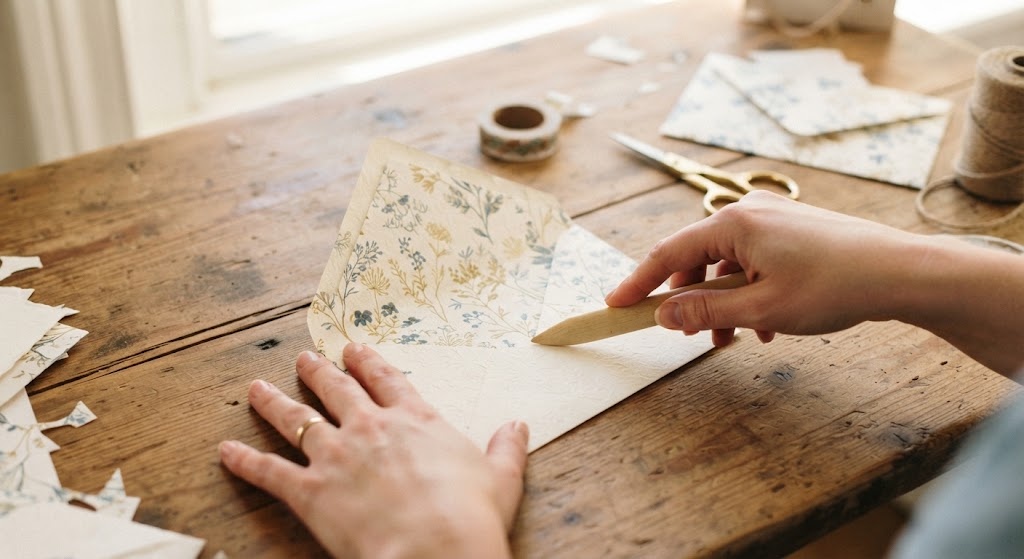
The right kind of fold is a flat and focused, sharp one. The crease can be defined by pressing down with the side of a fingernail, the tip of a finger or a suitable bone or folding tool, and pressing hard doesn’t mean better here; you don’t want to tear the top surface of flimsy patterned papers, and too much pressure or folding in the same crease again may crack the coating on coated paper.
A better technique is to establish the fold lightly, confirm that the edges are aligned, and then reinforce the crease.
That small habit makes homemade envelopes look dramatically cleaner.
What If the Envelope Does Not Close Properly?
This is one of the most common problems, and it usually has a simple cause.
The flap is too short
If the closing flap barely reaches the pocket, the proportions of the original folds may be off. Unfold the last few steps and check the reference creases rather than trying to stretch the paper into place.
The envelope is crooked
This usually means one of the early folds was not aligned with the center.
The farther you progress, the more noticeable that initial error becomes.
The pocket is too tight
Several layers of paper may have accumulated in the same area. A thinner sheet can help, or you may need to slightly adjust the fold positions.
The paper keeps opening
Some folded envelopes self-lock and are sealed this way, while other folded envelopes need to be sealed. If your folded envelope was not constructed with a self-locking flap use a small sticker, a decorative seal, or a re-usable tape. Historically sealing was significant in letters to prevent them from being tampered with, letterlocking could even be combined with wax seals or other methods to illustrate letter tampering.
A Square Paper Envelope Is Another Option
If you have origami paper rather than printer paper, a square sheet opens up another family of designs.
A popular instructional origami envelope uses a square piece of paper which is oriented like a diamond. Lines are formed from the center to the corners of the paper and each corner is folded a few times towards certain markers before being secured. An instructional tutorial for beginners uses 9.5-inch by 9.5-inch paper to create an envelope with roughly 6.7-inch by 4.2-inch dimensions.
The drawback of the square paper technique is the finish. You can have a more traditional “origami” look in the final product, which really shows well with designer papers or patterned papers like chiyogami.
One disadvantage is that a square does not always result in the most space efficient shape for postal purposes – more fitting for jotting notes, creating cards with gifts inside, or for placing gifts, cash or cherished mementos.
Why Paper Geometry Makes the Craft Work
An envelope looks simple because the finished object hides most of the engineering behind it.
The original sheet is flat. Folding is the establishment of new edges where none existed, and it requires the deletion of no matter. In folding, layers build upon themselves to form pockets and walls, and carefully placed flaps offer closures. Such constraints are the reason paper thickness, size, and fold location are critical; a thick paper may result in an awkwardly dense intersection, a thin one might not hold its shape, and an incorrectly placed crease could impede a fold to form a pocket. Understanding these details is an important part of learning how to fold an envelope out of paper.
It’s the reason that envelope folding has traditionally be seen as more than a parlor game. Pre-mass production making handcrafted envelopes required folding and sealing paper one envelope at a time. Making envelopes manually was such a slow and arduous process that the National Postal Museum states it took mechanical invention to begin modernizing envelope manufacturing in the 19th century. The modern craft therefore echoes an older practical technology, with the history of envelope making showing how hand-folded paper eventually evolved into commercially manufactured envelopes.
From Handmade Letters to Mass-Produced Envelopes
History gets even weirder when you realize the industrial envelope wasn’t the original default-the National Archives report that historical envelopes “were most often made individually” and therefore of a “patchy” construction, while the industrialization enabled some new production methods at scale. Meanwhile, developments in Victorian-era mail encouraged further innovation.
The shift was slow. Before the invention of commercially produced envelopes, letters can simply be folded and held shut, or tied closed. At MIT, the project letterlocking has been tracing how writers used ingenious folding as part of the letter-sealing process. It shows how the mail envelope we see today wasn’t so much invented new, as it returned to a very old approach: fold the paper up in such a way that it encloses its own message. This historical approach also gives useful context for how to fold an envelope out of paper.
That context makes the craft more interesting. You are not simply making stationery. You are reproducing, in miniature, a practical idea that existed long before modern office supplies.
Making the Envelope More Personal
Once you understand the basic structure, customization becomes easy.
For a birthday card, use colored or patterned paper and add a small sticker to the flap.
For a wedding or formal note, choose a restrained paper and make the folds exceptionally crisp.
For a cash gift, a smaller envelope can be more appropriate than a full-size mailing envelope.
For children’s crafts, inexpensive construction paper can turn the activity into an exercise in geometry and hand coordination.
You can also experiment with recycled maps, old magazine pages, sheet music, or clean wrapping paper. The best material is usually one that is visually interesting without being so thick or fragile that the folds become difficult.
When a Handmade Envelope Should Not Replace a Mailing Envelope
There is an important practical distinction between a decorative paper envelope and a postal envelope. If you’re learning how to fold an envelope out of paper, understanding this distinction helps you choose the right type of envelope for the occasion.
The folding of anything that will be going through the mail will need to accommodate the mailing service you use. Handmade envelopes could have rough edges, an odd shape, weak folds, or wouldn’t stay securely closed. For important documents, photos or anything else you don’t want arriving in pieces, a commercially produced mailing envelope would be a better option, whereas handmade works best for personal delivery, cards, notes, gifts, and decorative crafts.
The goal is not to pretend every paper fold is a replacement for industrial packaging. The goal is to understand what the handmade form does well.
A Better Way to Practice
Your first envelope does not need to be beautiful.
In fact, using your best decorative paper on the first attempt is often a mistake. Start with ordinary printer paper and treat it as a rehearsal.
Make the first one slowly.
Notice where the paper naturally wants to fold.
Pay attention to whether the corners meet.
Then make a second.
By the third attempt, the sequence becomes less mechanical because you begin to understand the geometry rather than merely following instructions.
That is one of the pleasures of paper folding: repetition turns instructions into intuition, which also makes easy paper crafts for beginners a natural next step for anyone enjoying the process.
Final Perspective
Learning how to fold an envelope out of paper is deceptively useful because the finished object teaches several things at once: proportion, alignment, material behavior, patience, and design.
The first sheet could appear simple and nothing special for some minutes it is already made out in a pocket which a flap, a little parcel for a present or a personal box for a nice word. This explain why the craft remained so loved nowadays although it takes almost any time in our days to send our message. Folded letter: it makes us take our time when it comes to our mail and make them material.
Best not is that that contains the largest numbers of origami complexities. It really has the best choice when there is no bad fold in it, which when you can handle the paper in not making some crazy decisions, and that the last flap fold in its place without redoing it, which by then you start learning to fold paper simply by its shape rather than instructions
Frequently Asked Questions
Can I make an envelope from regular printer paper?
And they are too. A lot of paper folded envelope origami uses standard paper and this kind of paper is very useful for practice, as it is so inexpensive to obtain one for experiments, it actually stands out among the A4 and Letter kind for good paper
Do I need scissors or glue to fold a paper envelope?
Not necessarily. Several origami-style designs can be completed from a single sheet using folds and tuck mechanisms. Other designs may use adhesive or a sticker for additional security.
What size paper makes the best envelope?
Depends on what you are using the envelope for A4 and letter size is good to use for practical rectangular envelopes, or if you’re making small envelopes or origami-type envelopes then square origami paper works well. The size of the finished envelope will always be slightly smaller than the sheet that you use it is already folded into.
Can I use wrapping paper to make an envelope?
Yes, provided the wrapping paper is reasonably sturdy and can hold a crease. Some origami instructions specifically recommend decorative wrapping paper as an alternative material.
Why does my envelope look uneven?
This is most likely caused by an inaccuracy in one of the early reference folds. Try opening the diagram out and correct center crease, and corner folds; rather than just the last flap. As in the early folds there is a larger error with each step.
Can a folded paper envelope be mailed?
It could be possible. However, it’s very unlikely not all handmade designs are built to withstand the journey by post. For anything special, look up the terms for your Postal service and perhaps just use a “standard mailer envelope” as it would afford protection and uniformity.
Is folding an envelope considered origami?
Absolutely. Origami basically has to do with changing the paper by folding it and the majority of envelope design involves some sort of folding. Envelope crafting also touches on a much more ancient practice, that of letterfolding and letterlocking, which was done for practical means of communication.