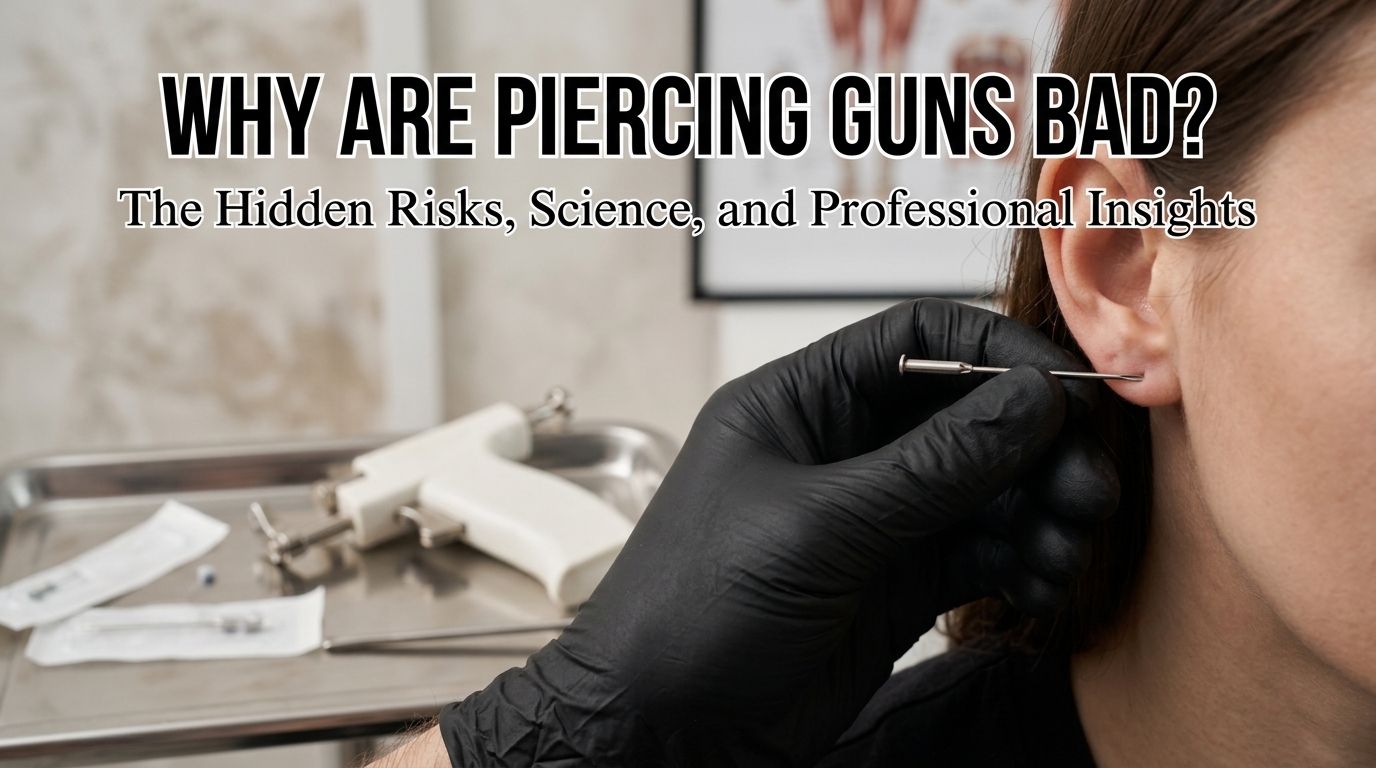
Whether you are planning your first ear lobe piercing or adding to a curated ear stack, choosing how that piercing is executed is just as important as selecting the jewelry. While mall kiosks and big-box retail stores have normalized the quick, low-cost convenience of spring-loaded plastic devices, professional body piercers and medical experts overwhelmingly agree on one principle: why are piercing guns bad comes down to blunt-force tissue trauma, impossibility of sterilization, improper jewelry design, and high rates of complications.
If you have ever wondered why are piercing guns bad compared to single-use hollow needles used by licensed professionals, the answer lies in physics, hygiene, and long-term tissue health. Understanding why are piercing guns bad helps protect your body from unnecessary scarring, chronic infection, cartilage shattered beyond repair, and prolonged healing times.
At a Glance: Piercing Guns vs. Professional Hollow Needles
To understand why are piercing guns bad, compare the mechanics, hygiene, and jewelry design of reusable piercing guns against professional hollow needles:
| Feature / Metric | Reusable Piercing Gun | Single-Use Hollow Needle |
| Primary Mechanism | Blunt force trauma (forces blunt stud through skin) | Precise surgical incision (removes tiny tissue core) |
| Sterilization Level | Impossible to autoclave (plastic melts) | 100% sterile (single-use, medical-grade needle) |
| Tissue Damage | High (tears tissue, risks cartilage shattering) | Minimal (clean, sharp incision promotes rapid healing) |
| Jewelry Quality | Mystery metals, butterfly backs (traps bacteria) | Implant-grade titanium, gold, flat-back labrets |
| Operator Expertise | Minimal retail training (often 1–2 hours) | Multi-year formal apprenticeship & bloodborne pathogen certified |
1. Blunt Force Trauma vs. Precision Incision
The primary mechanical reason why are piercing guns bad involves fundamental physics. A piercing gun does not actually “cut” or “pierce” the skin. Instead, it holds a blunt, dull-tipped earring stud and uses a spring-loaded trigger mechanism to force that stud directly through the skin and cartilage using sheer mechanical pressure.
┌──────────────────────────────────────────────────────────────────────────┐
│ PIERCING GUN vs. HOLLOW NEEDLE MECHANICS │
├──────────────────────────────────────────────────────────────────────────┤
│ PIERCING GUN: │
│ [Blunt Stud] ──► Mechanical Spring ──► Crushes & Tears Tissue │
│ (High Trauma & Scarring) │
│ │
│ HOLLOW NEEDLE: │
│ [Beveled Edge] ──► Sharp Incision ──► Creates Clean Pathway for Jewelry │
│ (Low Trauma & Fast Healing) │
└──────────────────────────────────────────────────────────────────────────┘
When asking why are piercing guns bad for softer earlobes and dense upper-ear cartilage, consider what happens at the cellular level:
- Torn Tissue: The blunt stud tears through skin and subcutaneous fat, leaving ragged edges rather than a clean channel.
- Prolonged Swelling: The crushing force causes localized cellular necrosis (cell death), leading to severe inflammation.
- Increased Keloids & Hypertrophic Scars: Severe tissue injury may trigger excessive collagen buildup, increasing the risk of raised or long-lasting scars.
2. Cartilage Shattering and Perichondritis
While blunt force trauma is problematic on soft earlobes, applying a piercing gun to dense ear cartilage (such as helix, tragus, or conch) can be disastrous. Understanding why are piercing guns bad for upper-ear cartilage involves understanding cartilage anatomy.
Blunt Stud Pressure ──► Fractures Avascular Cartilage Matrix ──► Triggers Perichondritis & “Cauliflower Ear” Deformity
Unlike earlobes, cartilage is avascular it lacks a direct blood supply and receives nutrients through a thin outer membrane called the perichondrium, which makes ear cartilage piercing risks especially important to understand. When a piercing gun slams a blunt stud into cartilage:
- The sudden force can shatter the surrounding cartilage matrix, creating microscopic fractures.
- The disrupted perichondrium loses its ability to feed the cartilage cells.
- Severe infections like perichondritis can set in, leading to structural collapse and permanent ear deformity.
This severe risk of cartilage failure is a major reason why are piercing guns bad and why professional body piercers strictly forbid their use on any part of the body above the lobe.
3. The Sterilization Dilemma: Plastic Cannot Be Autoclaved
A central hygiene issue explaining why are piercing guns bad is that reusable piercing guns cannot be sterilized.
┌──────────────────────────────────────────────────────────────────────────┐
│ THE AUTOCLAVE STERILIZATION IMPASSE │
├──────────────────────────────────────────────────────────────────────────┤
│ │
│ [Reusable Plastic Gun] ──► Exposed to Microscopic Blood & Fluid Spray │
│ │ │
│ ▼ │
│ [Autoclave Heat (270°F)]──► Plastic Melts and Destroys the Device │
│ │ │
│ ▼ │
│ [Alcohol Wipe Down] ──► Fails to Kill Bacterial Spores or Bloodborne │
│ Pathogens (Hepatitis B/C) │
│ │
└──────────────────────────────────────────────────────────────────────────┘
Professional body piercing studios rely on an autoclave a high-pressure steam sterilizer operating above 270°F (132°C) to eliminate all bacteria, viruses, and fungal spores from equipment, making piercing sterilization standards an essential part of safe piercing practices.
Because piercing guns are constructed primarily from plastic and internal metal springs, putting them inside an autoclave would melt the device. Cleaning a gun with disinfectant alcohol wipes only sanitizes the surface; it does not destroy bloodborne pathogens (such as Hepatitis B, Hepatitis C, or HIV) that can become trapped inside the spring mechanism during high-velocity pierces.
4. The Anatomy of “Butterfly Back” Jewelry
Examining the jewelry used in these devices highlights another clear reason why are piercing guns bad. Gun piercings almost exclusively use standard starter studs equipped with friction-based butterfly backs.
┌──────────────────────────────────────────────────────────────────────────┐
│ BUTTERFLY BACK HAZARDS │
├─────────────────────────┬────────────────────────────────────────────────┤
│ HAZARD FACTOR │ IMPACT ON HEALING PIERCING │
├─────────────────────────┼────────────────────────────────────────────────┤
│ **Bacteria Trap** │ Crevices collect dead skin, lymph, hair products│
│ │ and moisture, creating a breeding ground │
│ **One-Size Shafts** │ Short posts squeeze swelling tissue, leading │
│ │ to embedded jewelry and necrosis │
│ **Low-Grade Metals** │ Nickel-heavy alloys trigger contact dermatitis │
│ │ and chronic allergic reactions │
└─────────────────────────┴────────────────────────────────────────────────┘
Professional piercers use flat-back labrets made from implant-grade titanium (ASTM F-136) or solid 14k/18k gold with longer posts to accommodate post-piercing swelling safely.
5. Lack of Operator Training and Anatomical Knowledge
A key factor in why are piercing guns bad involves the training levels of the individuals operating them.
- Retail Operators: Employees in retail stores or mall kiosks typically receive 1 to 3 hours of basic video or demonstration training before piercing live customers. They rarely study bloodborne pathogen safety, cross-contamination protocols, or ear anatomy.
- Professional Body Piercers: Undergo rigorous 1 to 3 year apprenticeships, complete extensive coursework in anatomy and aseptic technique, and hold certifications in Bloodborne Pathogens (BBP), First Aid, and CPR.
Without formal training, retail operators frequently place piercings at crooked angles, misjudge ear anatomy, or fail to spot contraindications like cysts or delicate vein placements.
6. Incorrect Piercing Angles and Uneven Placement
If you are evaluating why are piercing guns bad from an aesthetic perspective, consider how gun mechanics affect piercing alignment.
Because piercing guns rely on a spring mechanism held by hand, the operator cannot adjust for subtle variations in tissue density. As the blunt stud forces its way through the ear, it follows the path of least resistance, frequently deflecting at an angle. This leads to misaligned, crooked piercings that make inserting straight jewelry uncomfortable or impossible later on.
7. What About “Single-Use” or Disposable Piercing Cartridges?
Some manufacturers offer disposable, plastic “piercing cartridges” or direct-pressure hand devices as an alternative to spring-loaded guns. While these single-use tools reduce cross-contamination risks, they do not resolve the primary core reasons why are piercing guns bad:
- They still use blunt studs that force their way through tissue rather than making a clean incision.
- They still rely on butterfly-back jewelry made from lower-grade metals.
- They are still operated by untrained personnel lacking deep anatomical expertise.
Whether spring-loaded or hand-pressured, any tool that forces a dull stud through tissue carries the same fundamental physical drawbacks.
Step-by-Step: Correcting a Bad Gun Piercing
If you already have a piercing done with a gun and are experiencing irritation, follow these steps to manage and correct the issue:
1.Step 1: Visit a Licensed Professional Piercer:Professional Evaluation.
Have a qualified professional piercer inspect the angle, tissue health, and jewelry fit. They can safely determine if the piercing can be saved or if it needs to be removed.
2.Step 2: Upgrade to Implant-Grade Titanium Jewelry:Jewelry Upgrade.
If the channel is viable, have the piercer replace the short, nickel-heavy butterfly stud with a sterile, implant-grade titanium flat-back labret that allows room for swelling.
3.Step 3: Switch to Sterile Saline Spray:Aftercare Routine.
Stop using harsh rubbing alcohol, hydrogen peroxide, or commercial “piercing lotions” provided by retail kiosks, and follow proper piercing aftercare recommendations instead. Clean the area twice daily with sterile 0.9% sodium chloride saline spray.
4.Step 4: Allow Proper Healing Before Re-Piercing:Safe Re-Piercing.
If the piercing is crooked or severely infected, remove the jewelry under professional guidance, allow the tissue to fully close and heal for 3 to 6 months, and then re-pierce the area safely using a sterile hollow needle.
Summary and Key Takeaways
To review why are piercing guns bad:
- Blunt Force Trauma: Guns tear skin and shatter upper-ear cartilage rather than creating a clean surgical incision.
- Cannot Be Autoclaved: Plastic construction prevents high-temperature steam sterilization, raising cross-contamination risks.
- Harmful Jewelry Design: Short posts and butterfly backs compress swelling tissue and trap bacteria.
- Untrained Personnel: Retail workers lack formal apprenticeships, bloodborne pathogen training, and anatomical knowledge.
- High Complication Rates: Gun-pierced holes suffer higher rates of infection, hypertrophic scarring, and crooked placement.
By choosing a reputable, professional body piercer who uses single-use hollow needles and implant-grade jewelry, you ensure a safer, smoother, and far more comfortable healing journey.